VoxFlow — a voice AI agent platform
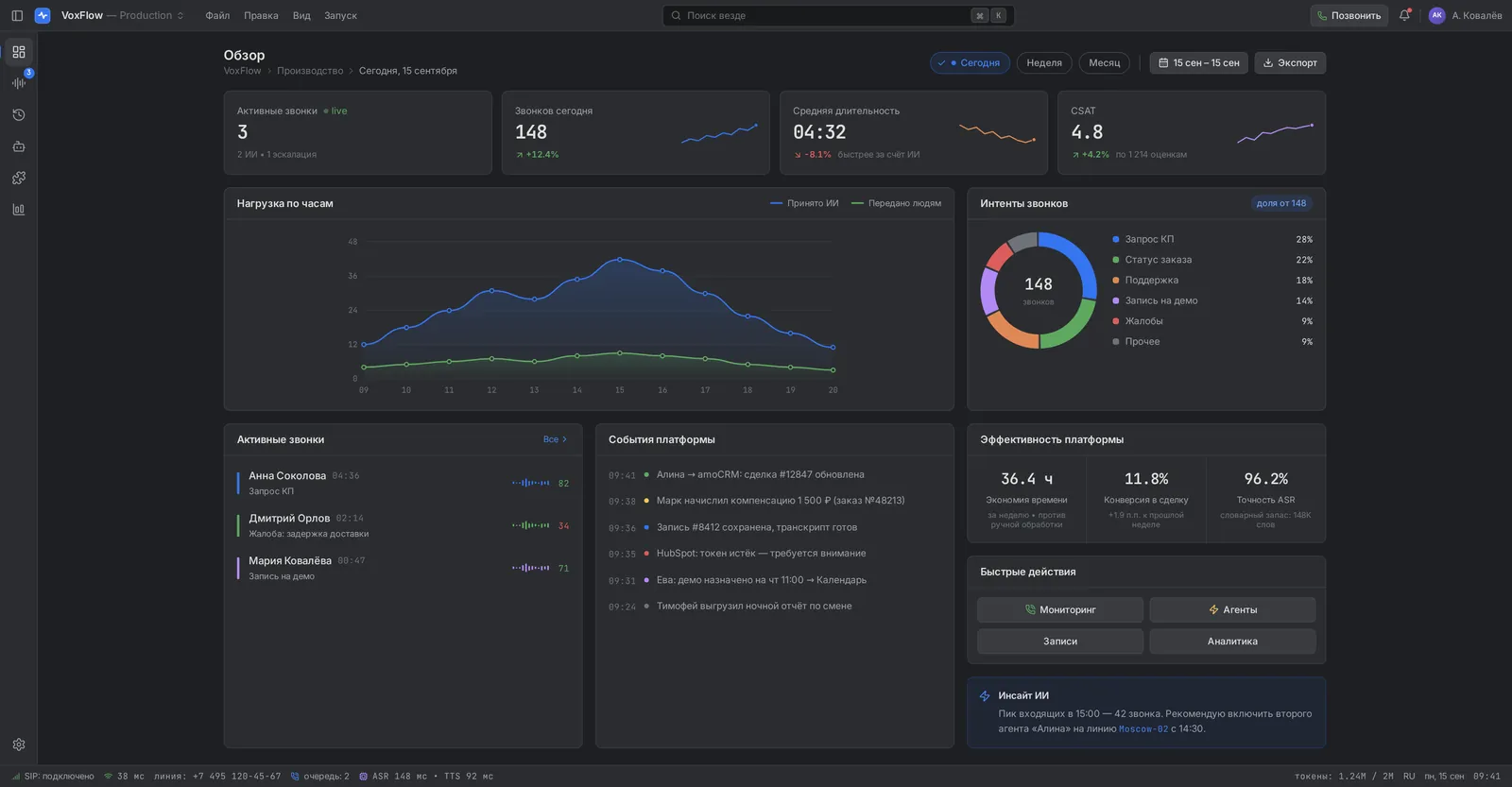
A voice agent is assembled from telephony, speech recognition, a language model, speech synthesis and your business system. We built a platform in which all of it is visible and controllable: from the milliseconds of recognition to the exact words the agent uses to answer a particular question.
How it looks inside
The interface is shown with demo data: we do not publish real cases, calls or client records.
What the product does
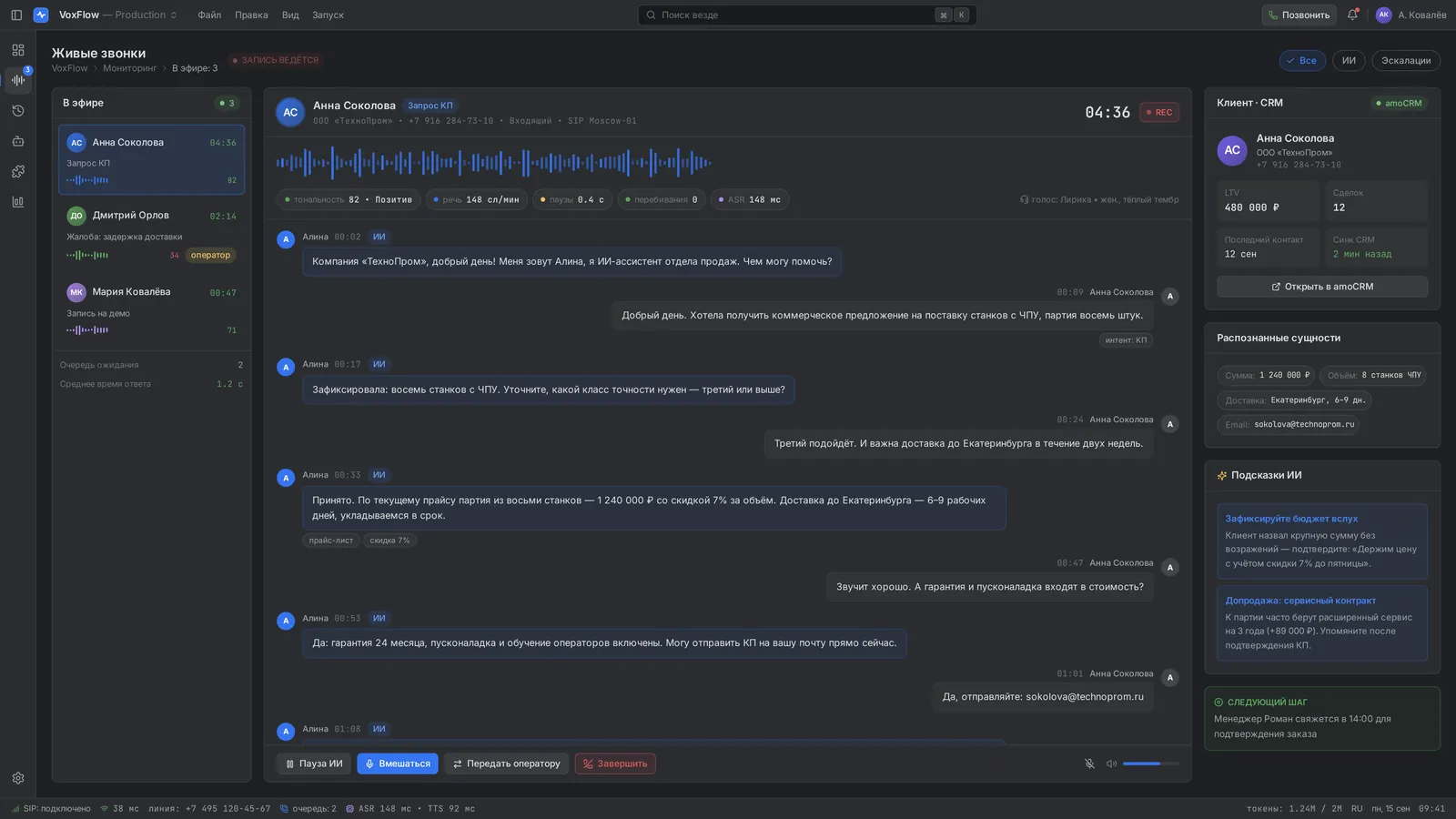
- A live monitor: who is on the line right now, what the conversation is about, its tone and pace of speech
- Real-time transcription split into the agent’s and the customer’s turns
- Entities recognised straight from the conversation: amount, volume, city and delivery date, email address
- The customer record from the CRM next to the conversation — history, deals, last contact
- Takeover in one click: pause the AI, step in by voice or hand the call over to an operator completely
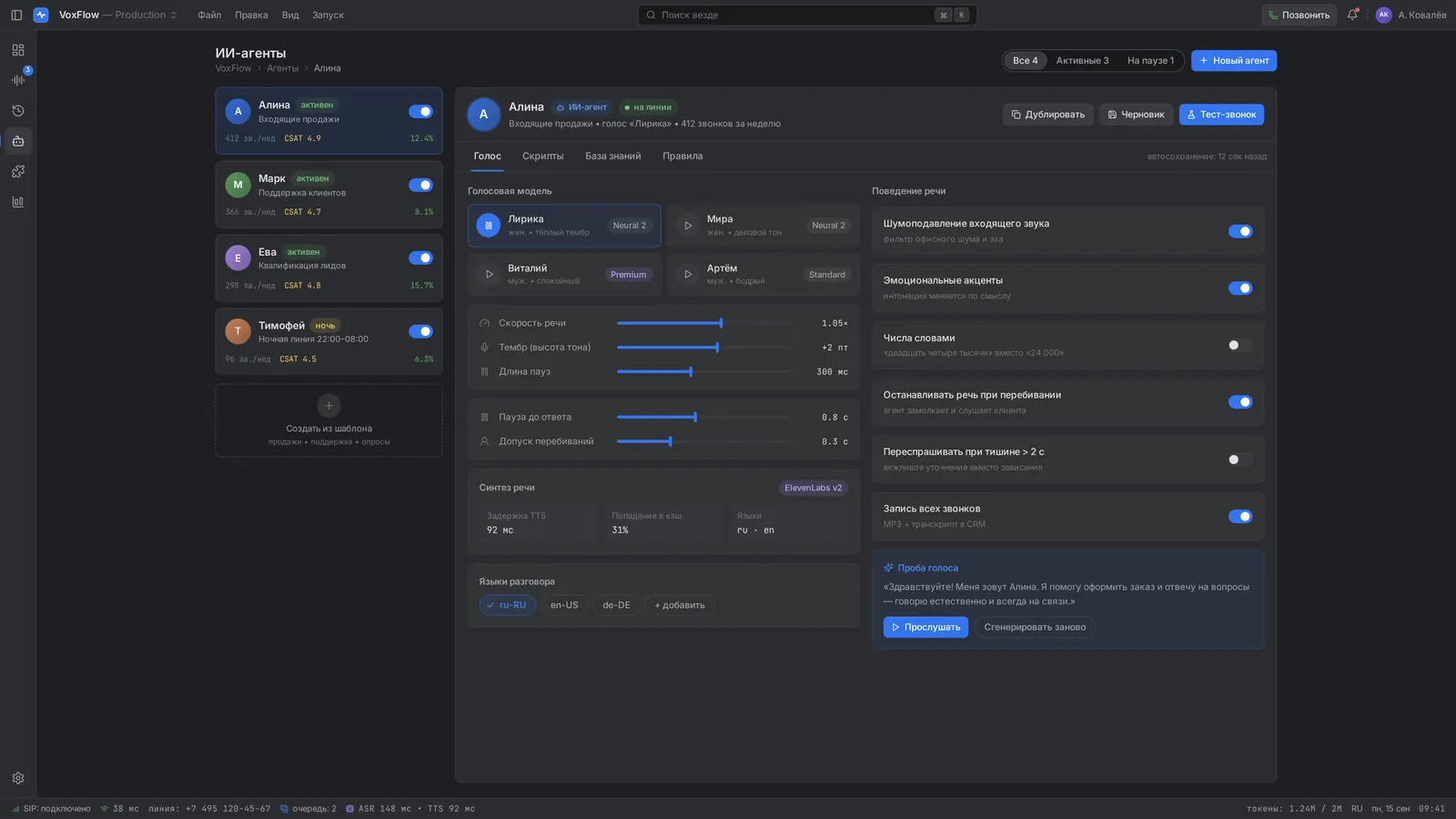
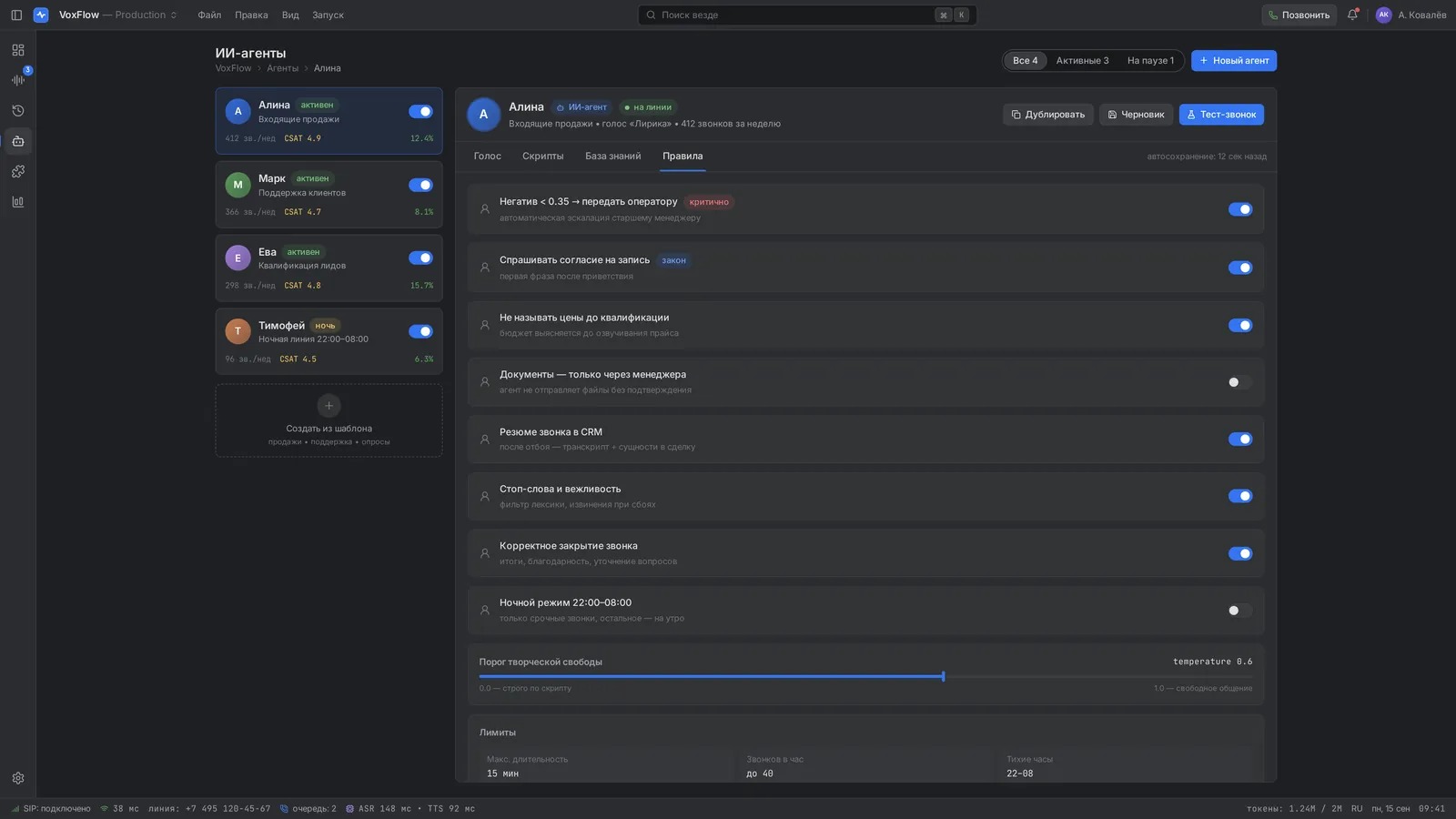
- An agent builder: voice, tone, rules, off-limits topics, conditions for escalating to a person
- Analysis by intent: why people call at all and what share of requests is closed without a person
A panel in which every conversation is visible
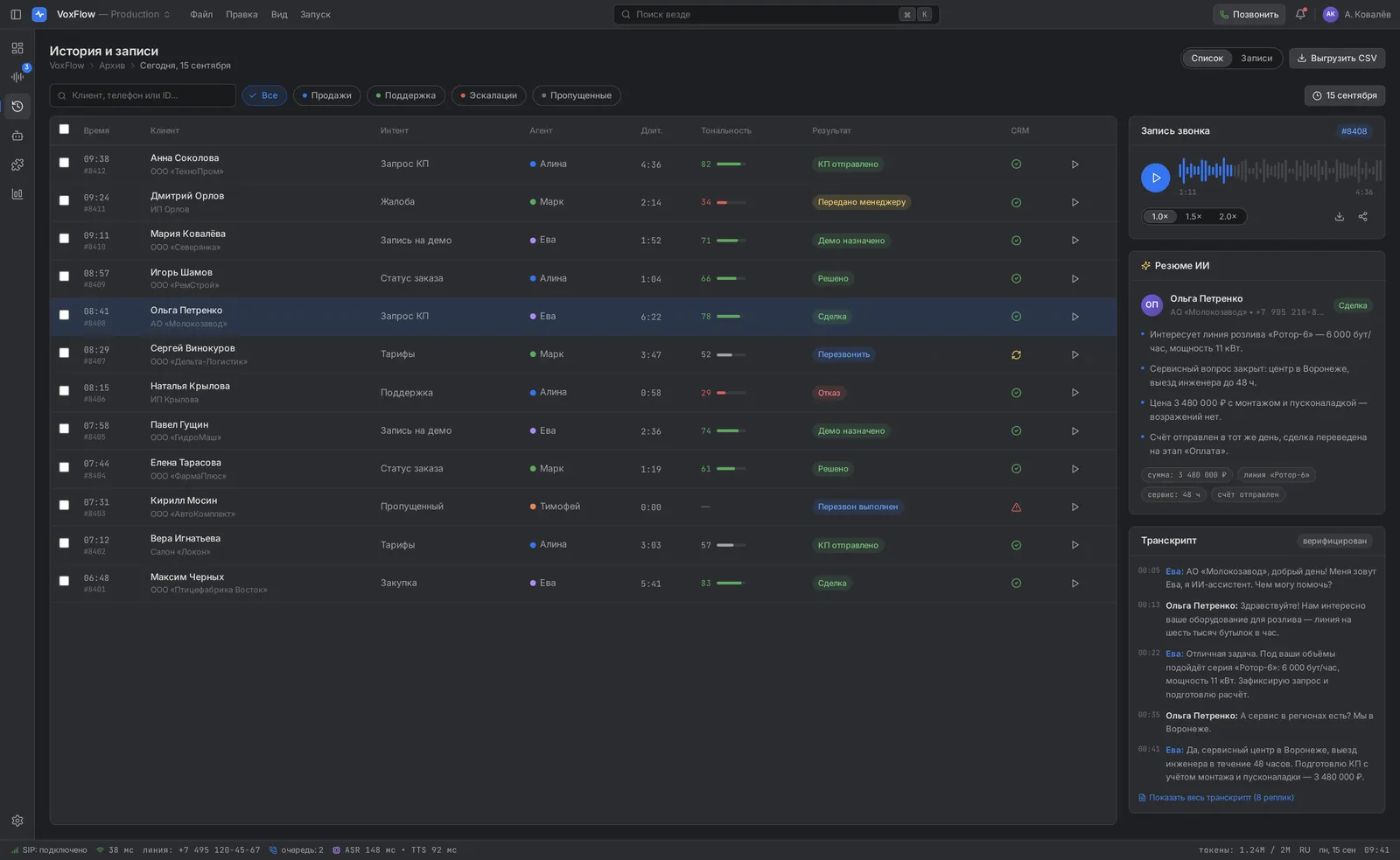
All work with the agent happens in one panel. Every call in it is laid out: the waveform of the conversation, the transcript by turns, the pace of speech and the pauses, the recognition and synthesis delay, the number of interruptions. Any conversation from any day opens in full — the recording next to the text, the recognised entities and the customer record from the CRM right there.
The agent is configured from the same panel: voice and tone, rules and off-limits topics, conditions for escalating to a person, the knowledge base it takes its answers from. A change applies to the next call — no deployment and no developer. Live calls are visible in real time, and from the same screen an operator pauses the AI, joins by voice or takes the conversation over.
How the agent knows what to say
The agent answers from your base: the price list, services, policies, answers to frequent questions, schedule and rules. For difficult cases explicit rules are set — what must not be promised, which topics are not to be discussed, which words mean a person has to be called immediately.
A separate part of the setup is how it sounds. Voice, tone, speed of speech, a pronunciation dictionary for names and product codes, the length of its turns. An agent that says the right things at the wrong pace is perceived as an answering machine, and you can see it in how quickly people hang up.
Integrations
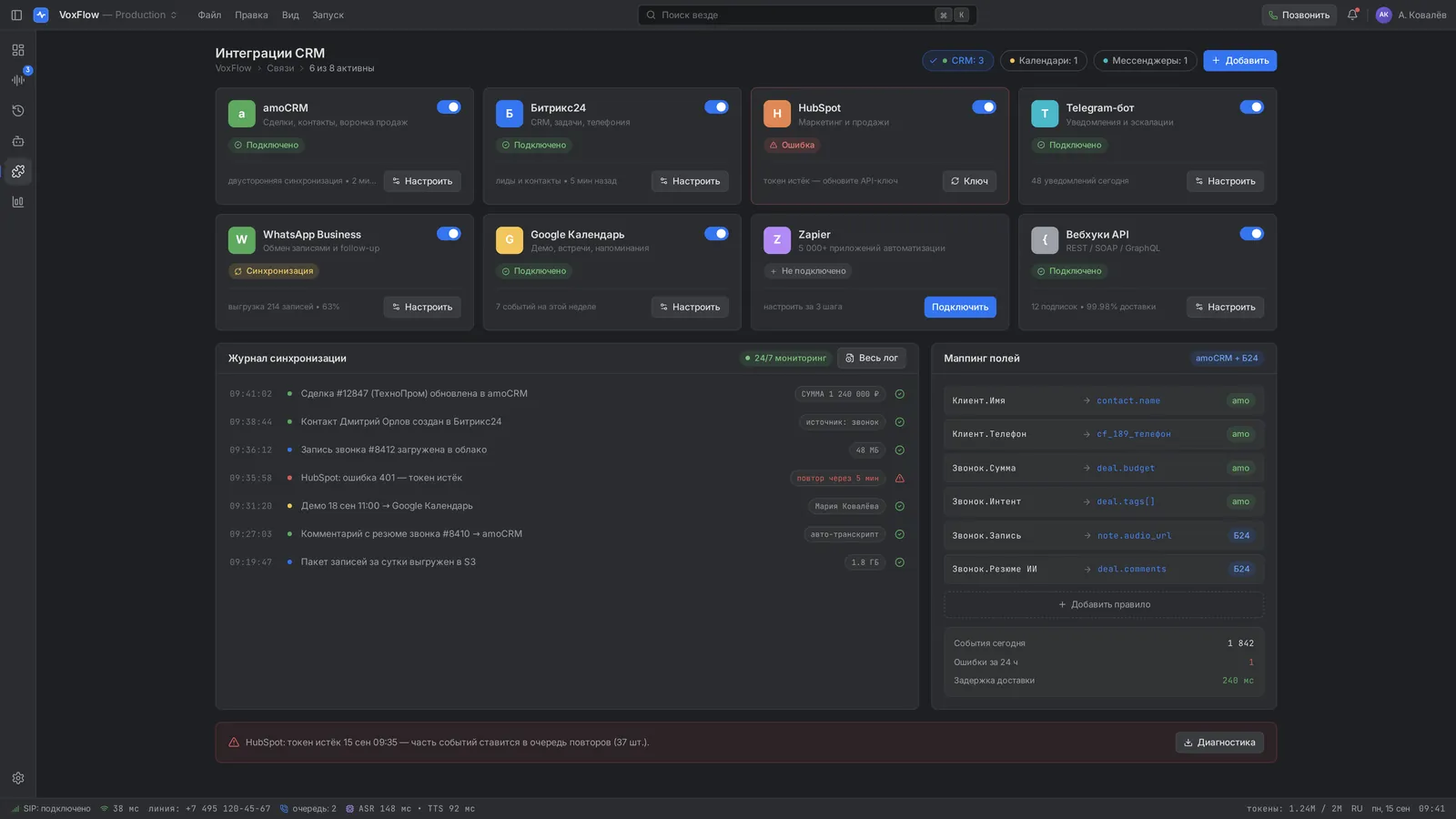
The agent connects to your existing telephony over SIP: the number, the carrier and the call recordings stay yours, and nothing needs to change. The result of the conversation goes where it is worked on — HubSpot and other CRMs: a deal or a task is created, and the transcript, the outcome and the fields recognised from speech — amount, volume, address, deadline, email — land in the customer record.
It works the same way in the other direction. Before its first word the agent sees the caller’s record: the history of requests, open deals, the last contact — and runs the conversation with all of that in mind. Where there is no ready connector, there are webhooks and requests during the call: check the stock in the warehouse, book a slot, send an email. Escalations and end-of-shift summaries arrive in Telegram.
Done to the highest standard
Latency. The whole chain fits between the end of the customer’s sentence and the start of the answer: recognition, the model, synthesis, the network. We brought it down to a pause that a person takes for the ordinary hesitation of the other side, and put every part of it into the interface — from the status line to the breakdown of a particular call.
Interruptions. Real people talk over each other, and the agent stops mid-word the way a person does: it hears the question, answers it and goes back to the interrupted thought. It is this mechanic, not flawless diction, that makes the conversation feel alive.
Honesty. The agent introduces itself as an assistant straight away, and the conversation does not suffer for it: people carry on calmly, because it answers to the point, at a human pace and without pretending to be an operator. Complaints along the lines of “I was talking to a robot and nobody told me” simply do not come up.
How it is built
- 1 Line The agent connects to your existing telephony over SIP — the number and the carrier stay yours
- 2 STT Speech is recognised as a stream: the agent starts answering while the sentence is still being spoken
- 3 LLM The model understands the intent and pulls entities out of the speech: amounts, volumes, addresses, deadlines, email
- 4 TTS The answer is synthesised in the chosen voice and spoken at a human pace, with pauses
- 5 Record The transcript, the outcome and the recognised fields go to the CRM, and the conversation stays in the history
What it is built with
Need something similar?
Tell us what is happening on your side now. Scoping and the estimate are free and commit you to nothing.